 FREE
Audio
FREE
AudioFriday, February 12, 2010
Matt Costello and Vanessa Franklin/Ninjagirl82 on Game Writing and more at Youtube.com
The writer of loads of games like Pirates of the Caribbean: World's End for X box 360 !!!!! and written novels and screenplays and loads. [And yes, he, too, despite what job HR types ask about, says he has LITTLE TIME TO PLAY games, since he's CREATING them.]
Matt Costello How 2 write video games, 2009
http://www.youtube.com/watch?v=QgzzQKYLHqE
The Game of Writing Games (Story and Games) with Matt Costello Pt 1/3, 2008
http://www.youtube.com/watch?v=syY3XY3LJgo
The Game of Writing Games with Matt Costello Pt 2/3, 2008
http://www.youtube.com/watch?v=RjL_1M-ZITI
The Game of Writing Games with Matt Costello Pt 3/3, 2008
http://www.youtube.com/watch?v=wfLv-NDFyoU
==========================
Writing for a video game part 1 by Vanessa Franklin/Ninjagirl82, 2007
http://www.youtube.com/watch?v=nw1KpoFMrNI
Writing for a Video Game Part 2, 2007
http://www.youtube.com/watch?v=YewxKtxsoV4
Writing for a Video Game Part 3, 2007
http://www.youtube.com/watch?v=BV4IspRB5KQ
===========================
Video Game Industry : How to Write Video Game Scripts from GameRecruiter
http://www.youtube.com/watch?v=0W_ImokXCUQ
Video Game Industry : Job Descriptions for a Video Game Designer
http://www.youtube.com/watch?v=AYzMAplBYhc
Video Game Industry : Qualifications for a Video Game Designer
http://www.youtube.com/watch?v=5LxE2iiEKpY
Video Game Industry : About Game Design Software
http://www.youtube.com/watch?v=RkmlWJQZUzs
[Steam is a digital distribution, digital rights management, multiplayer and communications platform developed by Valve Corporation. It is used to distribute a large number of games and related media entirely over the internet, from small independent efforts to larger, more popular games. Steam is set apart from similar services primarily by its community features, completely automated game update process, and its use of in-game functionality.
There are over 1,000 games available on Steam, and in January 2010 Valve announced that it had surpassed 25 million active user accounts.[3] It regularly services in excess of two million concurrent users.[4] Although Valve never releases sales figures, Steam is considered by its competitors and clients to be the market leader, controlling an estimated 70% of the digital distribution market.[5]
Many major publishers have catalogues on Steam, including Electronic Arts, Activision, 2K Games, Ubisoft, THQ, Sega, Codemasters, LucasArts, id Software, and BioWare.--Wikipedia http://store.steampowered.com/]
(0) comments
Matt Costello How 2 write video games, 2009
http://www.youtube.com/watch?v=QgzzQKYLHqE
The Game of Writing Games (Story and Games) with Matt Costello Pt 1/3, 2008
http://www.youtube.com/watch?v=syY3XY3LJgo
The Game of Writing Games with Matt Costello Pt 2/3, 2008
http://www.youtube.com/watch?v=RjL_1M-ZITI
The Game of Writing Games with Matt Costello Pt 3/3, 2008
http://www.youtube.com/watch?v=wfLv-NDFyoU
==========================
Writing for a video game part 1 by Vanessa Franklin/Ninjagirl82, 2007
http://www.youtube.com/watch?v=nw1KpoFMrNI
Writing for a Video Game Part 2, 2007
http://www.youtube.com/watch?v=YewxKtxsoV4
Writing for a Video Game Part 3, 2007
http://www.youtube.com/watch?v=BV4IspRB5KQ
===========================
Video Game Industry : How to Write Video Game Scripts from GameRecruiter
http://www.youtube.com/watch?v=0W_ImokXCUQ
Video Game Industry : Job Descriptions for a Video Game Designer
http://www.youtube.com/watch?v=AYzMAplBYhc
Video Game Industry : Qualifications for a Video Game Designer
http://www.youtube.com/watch?v=5LxE2iiEKpY
Video Game Industry : About Game Design Software
http://www.youtube.com/watch?v=RkmlWJQZUzs
[Steam is a digital distribution, digital rights management, multiplayer and communications platform developed by Valve Corporation. It is used to distribute a large number of games and related media entirely over the internet, from small independent efforts to larger, more popular games. Steam is set apart from similar services primarily by its community features, completely automated game update process, and its use of in-game functionality.
There are over 1,000 games available on Steam, and in January 2010 Valve announced that it had surpassed 25 million active user accounts.[3] It regularly services in excess of two million concurrent users.[4] Although Valve never releases sales figures, Steam is considered by its competitors and clients to be the market leader, controlling an estimated 70% of the digital distribution market.[5]
Many major publishers have catalogues on Steam, including Electronic Arts, Activision, 2K Games, Ubisoft, THQ, Sega, Codemasters, LucasArts, id Software, and BioWare.--Wikipedia http://store.steampowered.com/]
Labels: game designer, game scripts, matt costello, story and games, video game industry, write video games
Video Games and Sex
http://www.youtube.com/watch?v=oFywW99Uvwc
Here! Here!
A must see.
--Neale Sourna
(0) comments
Here! Here!
A must see.
--Neale Sourna
Labels: neale sourna, sex, sex in games, video games, youtube
An Answer to the Frustration of REAL Publishing at LinkedIn.com
Perhaps the real questions are do you want to wait a year or two to find an agent, and another yr or 2 to get an editor, and then a publisher?
Oh. Your editor just quit and you're agent's a dink. And you have to start over. How many years of your life will that take?
Or.
You get all your ducks in order and get that brass ring REAL publisher, that drops your book off market and makes it nearly impossible for anyone to buy--the very same year it's published!
These things are what I saw in my research before publishing, and also that many of the "self-publishing houses" had/have atrociously bad contracts. They are my books not theirs, if they wish to lease fine, if not, then a quick release of a few weeks should be doable.
You will be doing a lot of your marketing no matter who publishes it, but if you want to be certain it's out there long enough [takes about 5 yrs? for a Christmas Box or Joy of Sex] to become the next author-published goody that hits HUGE,.
So, you may consider joining we the author-published [also known as self-published and POD]. But, author publisher is cleaner, truer, and hasn't the baggage.
Check out the great contract at www.InfinityPublishing.com and call [I think it's still 877-BUY BOOK] and ask for their SAMPLE BOOK which is a perfect bound sample of the actual POD/print as they're purchased that they'll print for you with all the info to your questions. Their contract--if a huge house pick you up--can be released without any fuss, and within a few weeks. Not years.
And/Or invest in your own isbn's [www.isbn.org / www.bowkerlink.com] and upload to Ingram's www.LightningSource.com which prints and/or distributes pretty much all the big REAL publisher books and ebooks, as well as mine, to most booksellers online and brick and mortar.
And they don't stiff you with a ton of books to get waterdamaged in the garage or basement. You can order at cost and they'll ship for you to whoever needs to see your book, when you're marketing.
But they fulfill all bookseller [Amazon, BN, etc] orders without you, if you like. I like. I love.
All this requires learning more entrepreneurship skills and coordinating or doing your own editing, layout, and packaging.
All of my releases are still growing, and I'm set up now that if I want to write story or text, do layout, cover, and upload to them and have it go on sale within the same week. No. No bull....
Do look check them out, because putting your energy into--as the man said above--a dying system may not make you any happier.
Do you want to publish? Believe me the validation is there when you see your properties on sale across the net worldwide, and when you get your royalties, monthly, if you make sales.
Instead of 2-4 times a year from the majors, I believe it is.
This way is much work but there is much satisfaction and peace of mind, as well. And the years you spent chasing NYers or whomever, who by the way have been putting out badly edited and researched books, too, for a decade or more, have NOTHING to say about author publishing. Highly frustrating.
They are the big marketers nothing more.
So, you could use those years to learn epublishing and get your publishing company or a consortium group together and work on your books as a group.
Neale Sourna
www.PIE-Percept.com [publishing]
www.Neale-Sourna.com [author site]
www.Writing-Naked.com
www.LightningSource.com [national and worldwide print and distribution--ebooks (Adobe PDF/EPUB, MS, Palm), print books of all binding, interior color, and distributes to the new airport POD book kiosks]
(0) comments
Oh. Your editor just quit and you're agent's a dink. And you have to start over. How many years of your life will that take?
Or.
You get all your ducks in order and get that brass ring REAL publisher, that drops your book off market and makes it nearly impossible for anyone to buy--the very same year it's published!
These things are what I saw in my research before publishing, and also that many of the "self-publishing houses" had/have atrociously bad contracts. They are my books not theirs, if they wish to lease fine, if not, then a quick release of a few weeks should be doable.
You will be doing a lot of your marketing no matter who publishes it, but if you want to be certain it's out there long enough [takes about 5 yrs? for a Christmas Box or Joy of Sex] to become the next author-published goody that hits HUGE,.
So, you may consider joining we the author-published [also known as self-published and POD]. But, author publisher is cleaner, truer, and hasn't the baggage.
Check out the great contract at www.InfinityPublishing.com and call [I think it's still 877-BUY BOOK] and ask for their SAMPLE BOOK which is a perfect bound sample of the actual POD/print as they're purchased that they'll print for you with all the info to your questions. Their contract--if a huge house pick you up--can be released without any fuss, and within a few weeks. Not years.
And/Or invest in your own isbn's [www.isbn.org / www.bowkerlink.com] and upload to Ingram's www.LightningSource.com which prints and/or distributes pretty much all the big REAL publisher books and ebooks, as well as mine, to most booksellers online and brick and mortar.
And they don't stiff you with a ton of books to get waterdamaged in the garage or basement. You can order at cost and they'll ship for you to whoever needs to see your book, when you're marketing.
But they fulfill all bookseller [Amazon, BN, etc] orders without you, if you like. I like. I love.
All this requires learning more entrepreneurship skills and coordinating or doing your own editing, layout, and packaging.
All of my releases are still growing, and I'm set up now that if I want to write story or text, do layout, cover, and upload to them and have it go on sale within the same week. No. No bull....
Do look check them out, because putting your energy into--as the man said above--a dying system may not make you any happier.
Do you want to publish? Believe me the validation is there when you see your properties on sale across the net worldwide, and when you get your royalties, monthly, if you make sales.
Instead of 2-4 times a year from the majors, I believe it is.
This way is much work but there is much satisfaction and peace of mind, as well. And the years you spent chasing NYers or whomever, who by the way have been putting out badly edited and researched books, too, for a decade or more, have NOTHING to say about author publishing. Highly frustrating.
They are the big marketers nothing more.
So, you could use those years to learn epublishing and get your publishing company or a consortium group together and work on your books as a group.
Neale Sourna
www.PIE-Percept.com [publishing]
www.Neale-Sourna.com [author site]
www.Writing-Naked.com
www.LightningSource.com [national and worldwide print and distribution--ebooks (Adobe PDF/EPUB, MS, Palm), print books of all binding, interior color, and distributes to the new airport POD book kiosks]
Labels: bowkerlink, ebook, infinity publishing, international, isbn, lightning source, linkedin, neale sourna, perfect bound, pod, print book, worldwide
Monday, February 08, 2010
My Guilty Romances with Keanu Reeves, Lovers, and Writing
My Guilty Romances with Keanu Reeves, Lovers, and Writing
By Neale Sourna (Guest Blogger)
I write erotic fiction, both soft and hardcore, and sensuous and romantic game texts, and do so boldly. And even call my writing consulting site Writing-Naked.com, because I love writing, love to write, and love to have written—and yet I find, repeatedly, a middle class, middle American, Midwest, working class vibe of, “Hm, writing, that’s not REAL work, a REAL job you can do with pride, tell your grandma, and pay all your bills with.”
Like I had total pride and all my bills paid back when I was a secretary / executive assistant / office manager or retail salesperson or whatever. Absolutely not.
And my mom and grandma know what I write, even if they don’t read it.
“They” never leave you alone, nor does the noise in your own head, except unless you can prove you can afford to live in Anne Rice’s mansion, Stephen King’s gothic estate, or give the forever waving and REAL jobless Queen of England a run for her pound Sterling by being “Harry Potter’s” multimillion, writing mum.
And, probably, even then, you’ll have to tell yourself—until you believe it, too, and then some—that sitting on your bum, writing “little stories,” especially “little, romantic and erotic stories” IS REAL. And a guilt-free occupation.
That it’s more than okay.
That it’s really a breath of air filling your lungs, and a thing that keeps you sane.
Or, maybe, that’s just me.
And what does this have to do with Keanu...? http://lisabetsarai.blogspot.com/2010/01/my-guilty-romances-with-keanu-reeves.htmlLabels: erotic, fiction, keanu reeves, lisabet, romantic, sarai, stories, writing
Lisabet Sarai's Beyond Romance: I Believe...Some Words to Ponder
Monday, February 8, 2010
I Believe...Some words to ponder
This was sent to me by an old friend, but I thought it would bear sharing... I Believe... That just because two people argue, doesn' t mean they don' t love each other.. And just because they don' t argue, doesn' t mean they do love each other. I Believe... That we don' t have to change friends if we understand that friends change. I Believe... That no matter how good a friend is, they' re going to hurt you every once in a while and you must forgive them for that. I Believe... That true friendship continues to grow, even over the longest distance. Same goes for true love. I Believe... That you can do something in an instant that will give you heartache for life. I Believe... That it' s taking me a long time to become the person I want to be. I Believe... That you should always leave loved ones with loving words. It may be the last time you see them. I Believe... That you can keep going long after you think you can' t. I Believe... That we are responsible for what we do, no matter how we feel. I Believe... That either you control your attitude or it controls you. I Believe... That heroes are the people who do what has to be done when it needs to be done, regardless of the consequences. I Believe... That money is a lousy way of keeping score. I Believe... That my best friend and I can do anything, or nothing, and have the best time. I Believe... That sometimes the people you expect to kick you when you' re down, will be the ones to help you get back up. I Believe... That sometimes when I' m angry I have the right to be angry, but that doesn' t give me the right to be cruel. I Believe... That maturity has more to do with what types of experiences you' ve had, and what you' ve learned from them.....and less to do with how many birthdays you' ve celebrated. I Believe... That it isn' t always enough to be forgiven by others.. Sometimes, you have to learn to forgive yourself. I Believe... That no matter how bad your heart is broken the world doesn' t stop for your grief. I Believe... That our background and circumstances may have influenced who we are, but we are responsible for who we become. I Believe... Two people can look at the exact same thing and see something totally different. I Believe... That even when you think you have no more to give, if a friend cries out to you........you will find the strength to help. I Believe... That credentials on the wall do not make you a decent human being I Believe... That the people you care about most in life are taken from you too soon. As another friend recently wrote: He who dies with the fewest regrets wins. Warmly, Lisabet


Labels: beyond, blog, friends, i believe, lisabet, love, romance, sarai, words to ponder
Monday, February 01, 2010
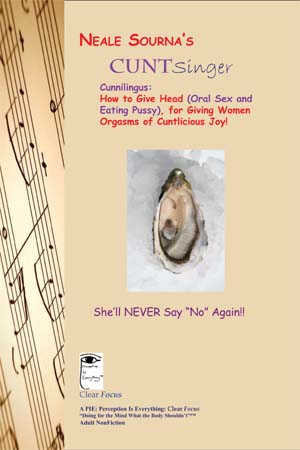
Download PROMO Sample of "Neale Sourna's CuntSinger"
"Neale Sourna's CuntSinger--Cunnilingus: How to Give Head (Oral Sex and Eating Pussy), for Giving Women Orgasms of Cuntlicious Joy!"
Did you know that:
Oral Sex, even CUNNILINGUS CAN GET HER PREGNANT, when YOU DO IT WRONG...?
So, do you know how to PROTECT HER...?
* * * * * * * *
You have a tongue and fingers, but is she really getting her FULL SATISFACTION from your lovemaking...?
Can you tell if she's satisfied, by more than her "yes" or "no" [if she's not too shy or fibbing]...?
How can you tell from HER SILENCE when she's REALLY SATISFIED...?
What can YOU DO TO SATISFY HER, when you've CUM/COME TOO SOON or have ROCKET FAILURE...?
Do you know the ways to help her when she believes oral sex--especially cunnilingus--is "gross," "icky," or whatever...?
Do you know HOW TO COAX HER to enjoy your oral lovemaking...?
**If you none of these, or know some and want to learn more, so YOU'LL BECOME A BETTER, MORE POWERFUL LOVER--keep reading, my friend....
http://www.cuntsinger.com/
Download:
http://www.cuntsinger.com/CuntSinger-Sample.htm
http://www.cuntsinger.com/CuntSinger-Sample.pdf
--Neale Sourna
(0) comments
Did you know that:
Oral Sex, even CUNNILINGUS CAN GET HER PREGNANT, when YOU DO IT WRONG...?
So, do you know how to PROTECT HER...?
* * * * * * * *
You have a tongue and fingers, but is she really getting her FULL SATISFACTION from your lovemaking...?
Can you tell if she's satisfied, by more than her "yes" or "no" [if she's not too shy or fibbing]...?
How can you tell from HER SILENCE when she's REALLY SATISFIED...?
What can YOU DO TO SATISFY HER, when you've CUM/COME TOO SOON or have ROCKET FAILURE...?
Do you know the ways to help her when she believes oral sex--especially cunnilingus--is "gross," "icky," or whatever...?
Do you know HOW TO COAX HER to enjoy your oral lovemaking...?
**If you none of these, or know some and want to learn more, so YOU'LL BECOME A BETTER, MORE POWERFUL LOVER--keep reading, my friend....
http://www.cuntsinger.com/
Download:
http://www.cuntsinger.com/CuntSinger-Sample.htm
http://www.cuntsinger.com/CuntSinger-Sample.pdf
--Neale Sourna
Labels: become a better lover, coax her, come too soon, cunnilingus, cuntsinger, eat pussy, give head, giving women, how to, neale sourna, oral sex, orgasms, powerful lover, rocket failure, satisfy her
Wednesday, January 27, 2010
Keanu Reeves' Film "A Walk in the Clouds" Audio Commentary by Author Neale Sourna
A ProjectKeanu.com Audio Commentary by author Neale Sourna (play along with your DVD): AWalkInTheClouds--1995.mp3
Fun, opinion, insightful, Free!
(0) comments
Fun, opinion, insightful, Free!
Labels: a walk in the clouds, commentary, dvd, film, free, fun, insight, keanu reeves, mp3, neale sourna, opinion, play along, project keanu
Armed Forces Press: Researchers Examine Video Gaming’s Benefits
Researchers Examine Video Gaming’s BenefitsBy Bob Freeman "We have discovered that video game players perform 10 to 20 percent higher in terms of perceptual and cognitive ability than normal people that are non-game players," said Ray Perez, a program officer at the ONR's warfighter performance department in a Jan. 20 interview on Pentagon Web Radio's audio webcast "Armed with Science: Research and Applications for the Modern Military." |
Labels: adapt, brain, defense, interactive, mind, modern military, operations, problem solvers, research, terrorists, training, video games, warfighters
Friday, January 15, 2010
Legal Battles Over E-Book Rights to Older Books
Legal Battles Over E-Book Rights to Older Books
By MOTOKO RICHWilliam Styron may have been one of the leading literary lions of recent decades, but his books are not selling much these days. Now his family has a plan to lure digital-age readers with e-book versions of titles like “Sophie’s Choice,” “The Confessions of Nat Turner” and Mr. Styron’s memoir of depression, “Darkness Visible.”


But the question of exactly who owns the electronic rights to such older titles is in dispute, making it a rising source of conflict in one of the publishing industry’s last remaining areas of growth.
Mr. Styron’s family believes it retains the rights, since the books were first published before e-books existed. Random House, Mr. Styron’s longtime publisher, says it owns those rights, and it is determined to secure its place — and continuing profits — in the Kindle era.
The discussions about the digital fate of Mr. Styron’s work are similar to the negotiations playing out across the book industry as publishers hustle to capture the rights to release e-book versions of so-called backlist books. Indeed, the same new e-book venture Mr. Styron’s family hopes to use has run into similar resistance from the print publisher of “Catch-22” by Joseph Heller.
On Friday, Markus Dohle, chief executive of Random House, sent a letter to dozens of literary agents, writing that the company’s older agreements gave it “the exclusive right to publish in electronic book publishing formats.”
Backlist titles, which continue to be reprinted long after their initial release, are crucial to publishing houses because of their promise of lucrative revenue year after year. But authors and agents are particularly concerned that traditional publishers are not offering sufficient royalties on e-book editions, which they point out are cheaper for publishers to produce. Some are considering taking their digital rights elsewhere, which could deal a financial blow to the hobbled publishing industry.
The tussle over who owns the electronic rights — and how much the authors should earn in digital royalties — potentially puts into play works by authors like Ralph Ellison and John Updike.
Some publishers have already made agreements with authors or their estates to release digital editions. All of Ernest Hemingway’s books, for example, are available in electronic versions from his print publisher, Scribner, a unit of Simon & Schuster.
But with only a small fraction of the thousands of books in print available in e-book form, there are many titles to be fought over.
“This is a wide open frontier.....[more at http://www.nytimes.com/2009/12/13/business/media/13ebooks.html#]A version of this article appeared in print on December 13, 2009, on page A1 of the New York edition.
========
And people ask why I publish my own works. Yes, it's work and like a voice crying in the wilderness all alone; but, it's my voice. And autonomy and independence and knowing my titles aren't ignored or pulled out of rotation for no apparent reason except boredom in waiting for the BIG NUMBERS by "my publisher" for a huge, star customer other than myself--I'm my own star!--is worth the sleep at night.--Neale Sourna
Labels: backlist, confessions of nat turner, darkness visible, e-book, ebook, formats, heller, infinity publishing, kindle, legal battles, random house, revenue, rights, sophie's choice, styron, titles
Sunday, January 10, 2010
Interview Myths That Keep You From Landing the Job
With so few jobs currently available and so many people currently hoping to fill those jobs, standing out in an interview is of utmost importance. While jobs themselves are scarce, job advice is overly abundant. And with an influx of information comes an influx of confusion. What career counsel do you take, and what do you ignore?
There are a number of common misconceptions related to interview best practices, experts say. Kera Greene of the Career Counselors Consortium and executive coach Barbara Frankel offer tips below that can help you stand out from other interview subjects, avoid frequent pitfalls, and secure the job.
Myth #1: Be prepared with a list of questions to ask at the close of the interview.
There is some truth in this common piece of advice: You should always be prepared, and that usually includes developing questions related to the job. The myth here is that you must wait until it is "your turn" to speak.
By waiting until the interviewer asks you if you have any questions, "it becomes an interrogation instead of a conversation," says Greene.
Greene recommends that you think of an interview as a sales call. You are the product and you are selling yourself to the employer. "You can't be passive in a sales call or you aren't going to sell your product."
Frankel mimics Greene's comments. "It's a two-way street," she says. "I recommend asking a follow-up question at the tail end of your responses."
For example, Frankel says, if the interviewer says, "Tell me about yourself," you first respond to that question and complete your response with a question like, "Can you tell me more about the position?" The interview should be a dialogue.
Myth #2: Do not show weakness in an interview.
The reality is that it is OK to have flaws. In fact, almost every interviewer will ask you to name one. Typically job seekers are told to either avoid this question by providing a "good flaw." One such "good flaw" which is often recommends is: "I am too committed to my work." But, these kinds of responses will only hurt you.
"Every recruiter can see through that," Greene says of faux flaws.
Recruiters conduct interviews all day, every day. They've seen it all and can see through candidates who dodge questions. "They prefer to hire someone who is honest than someone who is obviously lying," Greene says.
And for those of you who claim to be flaw-free, think again. "Everybody has weaknesses," Frankel states. But one is enough. According to Frankel, supply your interviewer with one genuine flaw, explain how you are working to correct it, and then move on to a new question.
Myth #3: Be sure to point out all of your strengths and skills to the employer.
Of course, you want the interviewer to know why you are a valuable candidate, but a laundry list of your skills isn't going to win you any points. Inevitably, in an interview, you will be asked about your skills. What can go wrong in this scenario?
"You don't want to list a litany of strengths," Frankel says.
"What is typical is that they will say: 'I'm a good communicator,' 'I have excellent interpersonal skills,' 'I am responsible,'" Greene explains. "You have to give accomplishments. I need to know what did you accomplish when using these skills."
Frankel recommends doing a little groundwork before your interview so that you are best equipped to answer this question. She tells her clients to find out what the prospective job role consists of. "What makes an interview powerful is to give an example related to their particular needs or challenges that you have demonstrated in the past."
Provide three strengths, with examples. You will get much further with a handful of real strengths than with an unconvincing list of traits.
Myth #4: Let the employer know your salary expectations.
One of the trickiest questions to answer in an interview relates to salary. Money talk can be uncomfortable, but it doesn't have to be. The fact is you don't even have to answer when asked about desired salary.
According to the book "Acing the Interview: How to Ask and Answer the Questions That Will Get You The Job!" a perfect response would be: "I want to earn a salary that is commensurate with the contributions I can make. I am confident I can make a substantial contribution at your firm. What does your firm plan to pay for this position?"
Greene suggests a similar response: "I prefer to discuss the compensation package after you've decided that I'm the best candidate and we can sit down and negotiate the package."
Myth #5: The employer determines whether or not you get the job.
While yes, the employer must be the one to offer you the position, interviewees have more control than they often realize. According to both Greene and Frankel, candidates have a larger say in the final hiring decision than they think.
"They should call the interviewer or hiring manager and say: 'I'd really like to be part of the company,'" says Greene. "It can't hurt you. It can only help."
"Acing the Interview" encourages all candidates to conclude their interviews with one question: "'Based on our interview, do you have any concerns about my ability to do the job?' -- If the answer is yes, ask the interviewer to be explicit. Deal forthrightly with each concern."
For more interview tips and myths, download a free book summary of "Acing the Interview: How to Ask and Answer the Questions That Will Get You The Job!" here.
Also on Yahoo! HotJobs:
'Accomplishments' to leave off your resume
6 reasons they didn't call you back
Should you keep your salary a secret?
Find a new job near you
Labels: acing the interview, career, career counselors consortium, dialog, follow-up question, interrogation, interview, job, karen noonan, salary expectations, sales call, skills, tradpub